





The Land Is Not Our Own: Seeking Repair Alongside Indigenous Communities
Indigenous Justice Series
Find a group & registerSeeking Repair Alongside Indigenous Communities
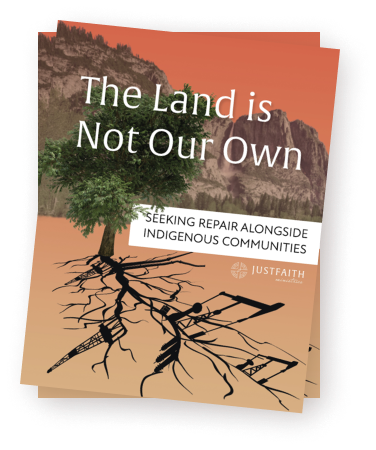
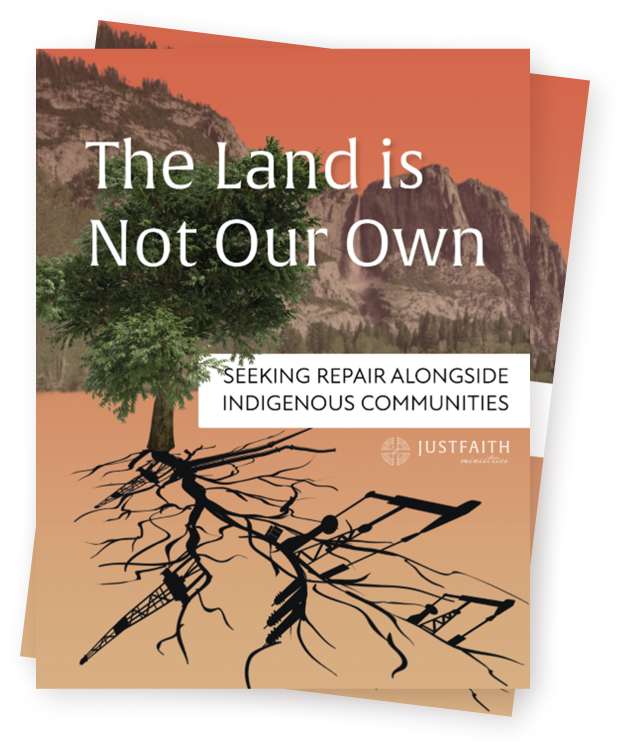
The Land Is Not Our Own: Seeking Repair Alongside Indigenous Communities inspires and equips people of faith to stand alongside Native communities in working for justice and repair.

Program Overview
“It is your right, your birthright, to seek out others to work toward a world you imagine, a world where we are all free.” — Sarah Augustine
This small group process lays a foundation of trust and relationship, so that together participants can acknowledge injustice, honor the interconnectedness of all Creation, and seek healing, repair, and hope alongside Indigenous communities.
Goals for The Land Is Not Our Own: Seeking Repair Alongside Indigenous Communities include:
Guide participants in “discern[ing] how Christian communities can address the extinction, enslavement, and extraction done in the name of Christ on Indigenous lands.” From The Coalition to Dismantle the Doctrine of Discovery
Equip communities and congregations to seek justice and repair in solidarity with Indigenous leaders.
Celebrate the wisdom and traditions of Indigenous authors, artists, and spiritual teachers.
Through spiritual reorientation, inspire daily decision-making that honors participants’ sacred relationships with all of Creation.
Transform a collection of 8-14 individuals into a community of love and support. The members of your community will continue to encourage one another as you seek spiritual transformation and take action for justice after the program has finished.
The Land Is Not Our Own: Seeking Repair Alongside Indigenous Communities consists of eight 2-hour sessions and an immersion experience.
Recommended group size is 8-14.Program Framework & Session Topics
-
Session 1: The Places We Call Home
-
Session 2: Whose Land?
-
Session 3: Sacred Land, Sacred Air, Sacred Water
-
Session 4: Stolen Children
-
Session 5: Exile
-
Session 6: Honoring Indigenous Women
-
Immersion Experience
-
Session 7: “We Are Still Here!”: Sovereignty and Representation
-
Session 8: “Solidarity is Not Symbolic”
Sessions include:
 Prayer and reflection
 Discussion of reading
 Videos & group activities
 Spiritual practices
 Integration of faith
Want to know more?
An overview, sample session, and program booklet are available for free download.
What you’ll need for this program
There are two books used in The Land Is Not Our Own — Available through our JustFaith Ministries Bookstore.
Need help inviting people to your small group?
This program promotion kit contains sample social media posts, bulletin announcements, email invitations, and more.
We believe strongly in making our programs inclusive and available to everyone
Cost should never be a barrier to participation, and we are committed to working with individuals and organizations to ensure meaningful access through flexible pricing options. Why do we use a sliding fee scale?
There are Two Registration Options:
Option 1: Individual Participant Registration
Participants register and pay individually using a sliding-scale fee of $45, $60, or $75 per person, based on ability to pay. If $45 is still inaccessible, participants can choose the Pay-What-You-Can option to choose a price that is right for them.
- There is no charge for up to two facilitators.
- A minimum of 8 participants is strongly recommended.
Option 2: Organization-Sponsored Registration
A church or organization may choose to cover registration for all participants using a sliding fee scale of $45, $60, or $75 per person, based on ability to pay.
- The organization will be billed a flat rate of the amount chosen below, which covers up to 8 participants.
- For groups larger than 8, the organization will be invoiced an additional $45, $60, or $75 per participant when the group begins, price depending on the chosen amount below.
- If the lowest fee is inaccessible to your organization or ministry, choose the Pay-What-You-Can Rate to learn about shared-cost or reduced-fee options.
What the Registration Fee Includes
- Comprehensive materials for each session (instant download upon purchase)
- Facilitation scripts, guidance, and training resources
- Retreat and immersion planning assistance
- Adaptations for virtual groups
- Direct access to program staff for ongoing support
- Books are an additional cost and may be purchased separately through the bookstore.

To ensure our programs remain accessible while remaining sustainable, we utilize a sliding fee scale of $45 to $75 for our registrations. We invite you to choose the registration tier that best reflects you or your faith community's current financial reality. Paying on the higher end allows us to keep the program affordable for all.
We also offer a Pay-What-You-Can Rate. If the lowest rate does not seem accessible to you or your church at this time, don’t let this be a barrier to participation. Contact our staff here to learn about shared-cost or reduced fee options.


What our program participants are saying
I recently participated in The Land Is Not Our Own, and it has been a real revelation to me. The first step is awareness and knowledge, followed by action, and this program can be an important catalyst in one’s journey. I also received an unexpected gift of increased reverence for the wonders of creation that are all around us, an appreciation that, in the long-term, may hold the key to our very survival as a species.
“The Land is Not Our Own has allowed me the space to honor both my Christian faith and my indigeneity. I have gained a deeper understanding of how to communicate existing in both worlds by sharing with a faith-centered group that is open and empathetic. Our call as people of faith is to journey with the oppressed, and this [program] welcomed being witness to the beauty of indigenous culture and spirituality while also holding space to reckon with the horror experienced by indigenous peoples. We cannot build a better future and world without confronting the sin of genocide that continues to manifest in and through our current systems. This course fostered prayerful critique of history, as well as stoking creative solutions to how to repair the harms of colonization and assimilation, specifically as Christians, both individually and as a group. Together we felt the woundedness of genocide and violence, as well as the hope, creativity, and joyful resilience that indigenous people have carried, carry now, and will carry into future generations.”
The Land is Not Our Own Overview, Sample Session, and Program Booklet
To get access to this program's overview, sample session and program booklet, complete the form below and you will receive an email with the downloadable materials.
The Land is Not Our Own Promotion Kit
To get access to this program's promotional materials, complete the form below and you will receive an email with the downloads.